


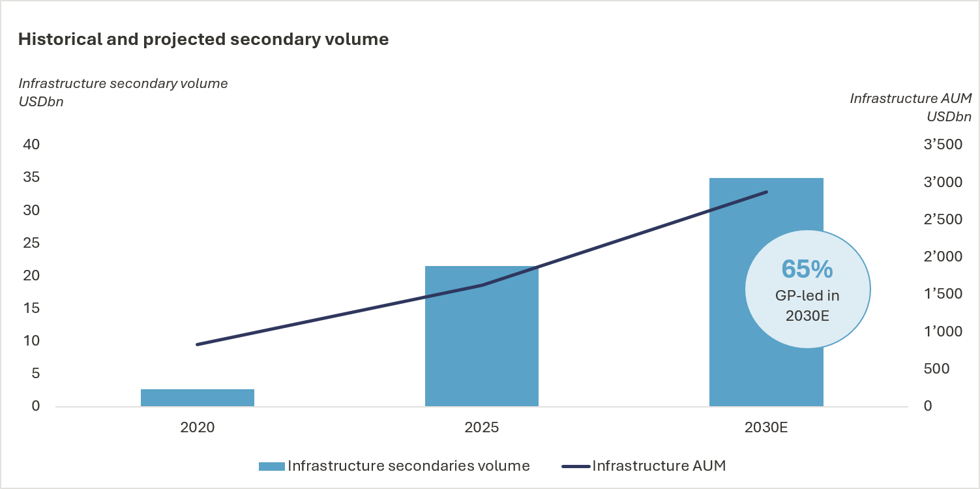
Infrastructure secondaries: Underwriting the next phase of infrastructure assetsBY MARTIN PATEK | TUESDAY, 10 NOV 2026 4:29PM As infrastructure has become one of the fastest-growing areas of private markets, the nature of the asset class has changed. Investments have moved from single assets to large, capital-intensive platforms that keep expanding well beyond a fund's life. This is also reshaping the secondary market: having once been regarded primarily as a liquidity tool, infrastructure secondaries now increasingly offer investors access to platforms with an established operating history as they scale and enter their next phase of growth. GP-led transactions are at the centre of this shift. Infrastructure underpins the services that people use every day: power, transport, digital connectivity, logistics and healthcare. Historically, many investors accessed infrastructure through listed utilities, airports, towers or energy companies. Today, much of this opportunity is to be found in private markets, where assets under management have grown by more than 15% per year over the past decade to around US$1.6 trillion, according to Preqin. More importantly, however, infrastructure investments have also evolved in qualitative terms. They are no longer limited to individual, mature assets such as toll roads, bridges or wind farms. Today, they increasingly include scalable operating platforms, such as data centers and fiber networks, renewable energy and storage businesses, or smart metering companies. These platforms have been built over years and continue to grow as a result of new projects, acquisitions and capacity additions. When fund lives end before growth does That creates a timing problem. A platform may have delivered on its original plan and yet its most valuable growth may still lie ahead - precisely when the fund that owns it approaches the end of its life or has fully deployed its capital. A conventional sale would hand that upside to a new owner. This is where GP-led secondaries come in. Rather than selling the asset, the manager moves it into a new vehicle, allowing existing investors to take liquidity, new investors to fund the next phase and the manager to keep building a business it knows intimately. Crucially, incoming investors who already participated in the original fund may know the asset almost as well as the manager, having followed its performance for years. A market coming of age The numbers show how quickly this market has gone mainstream. Infrastructure secondary volumes have soared from less than US$3 billion in 2020 to approximately US$20 billion in 2025, and GP-led deals accounted for roughly 78% of infrastructure secondary volume in the first half of 2026, according to Campbell Lutyens What was once a last resort for distressed sellers is now an established structure for extending the ownership of assets beyond a fund's life. For investors, these transactions can offer exposure to known operating platforms rather than a blind pool, as well as the ability to underwrite against actual operating history, and entry points that may reflect seller's need for liquidity rather than a deterioration in the asset itself. Why the sector label tells you little There is a catch, however: these opportunities are far less uniform than they look. It is no longer enough to know that an asset is part of the digital infrastructure or the energy transition. Two data center platforms can have contrasting risk profiles: one with contracted revenues and a proven expansion model, while the other may be dependent on speculative development. What matters is the specific business: its stage, scale, customer base, capital needs and the credibility of its growth plans. The question that investors must ask is not what the asset looks like today, but what it can realistically become in the future. Gaining the edge This is also what makes the strategy demanding. A GP-led transaction typically centers on one or a few assets, and the real task is underwriting future growth. The key questions to ask here are: how much capital is still needed, whether the plan is credible and whether management can deliver? Because the manager sits on both sides, alignment and pricing must be scrutinized carefully. Not every transaction clears that bar. Future growth and value creation may also differ materially from expectations, which is why underwriting has to rest on a careful assessment of the underlying assets, the transaction structure and the resulting risk-return profile. The edge comes from already knowing the asset and the manager, from proprietary insights as an existing investor, and from having sufficient deal flow to compare opportunities and stay selective. Scale and access are therefore not about vanity; they are what separate genuine relative value discipline from simply taking what is being offered. Growing relevance Infrastructure secondaries are no longer mainly about liquidity. They are now becoming a way to back successful platforms through their next stage of growth with the right ownership, capital and time horizon. That also means that the discipline is increasingly focused on a blend of infrastructure expertise and private equity-style value creation. As the asset class grows larger, more private and more platform based, we believe the winners will be defined less by their ability to acquire existing exposures at a discount and more by their capacity to judge what infrastructure businesses will become next.
|


Latest News
Australia's family offices surpass $323bn in assets
Mining, property fuel Aussie billionaires' wealth
HNWIs demand outperforming, mission-driven endowment funds
Family businesses turn to external chief executives: Deloitte

Cover Story

Generation next
FINANCE DIRECTOR
GOWING BROS LTD
Expert Feed

What I told a room of financial advisers about divorce

It's a commodities supercycle, but not as you know it

How your clients can start leaving a legacy now